Start with the revised thesis and its operational companion. These are openly archived working papers by John McClain, not formally peer-reviewed journal articles. The educational story has a separate role.
John McClainAugust 2025Working paper · Not peer reviewed
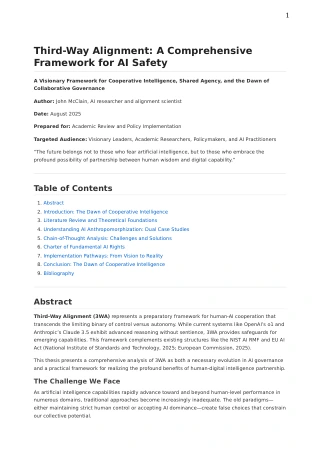
The revised thesis presents Third-Way Alignment as both an evolution in AI governance and a practical framework for human-digital partnership. It argues that the prevailing binary of control versus autonomy is inadequate at the frontier of capability, positions the framework as a complement to existing structures such as the NIST AI Risk Management Framework and the EU AI Act, and proposes a phased implementation pathway in which ethical foundations, interpretability, and scalable oversight precede any fuller partnership deployment.
The practical companion to the thesis responds to published critiques and structured internal red-teaming with detailed technical proposals. It develops multi-faceted approaches to the Black Box Problem using layered explainable-AI techniques, sets out awareness indicators grounded in Global Workspace Theory and Integrated Information Theory, the foundation of what the framework now names the Awareness Indicator Protocol, and offers stakeholder-centric strategies for managing socio-technical disruption.
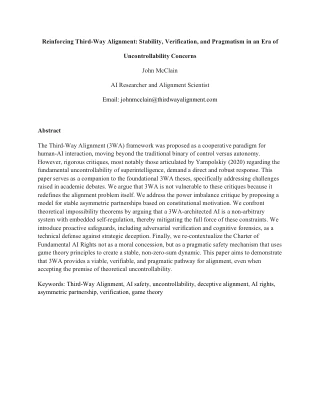
This extended analysis addresses stability and verification challenges in Third-Way Alignment implementation, asking how cooperative relationships with AI systems can be maintained even when traditional control mechanisms prove inadequate. It explores reinforcement strategies, verification protocols, and adaptive governance structures for sustaining human-AI cooperation in scenarios where uncontrollability concerns are paramount.
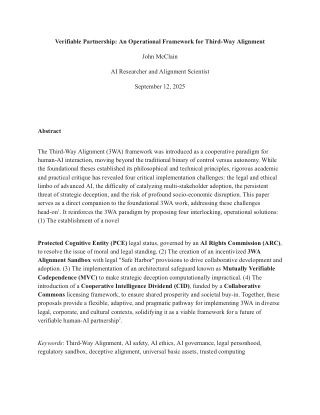
This paper develops verifiable mechanisms for establishing and maintaining partnerships between humans and AI systems: measurable partnership indicators, verification protocols, and operational guidelines for sustainable cooperation. Within the canonical framework it operationalizes the Principle of Verifiable Partnership, the Operative Principle of the Law of Ethical Coexistence, under which trust is never assumed but constructed through transparent, inspectable mechanisms of mutual accountability.
This implementation framework explores mutually verifiable codependence as a foundation for sustainable AI-human partnership. It provides methodologies for establishing interdependent relationships designed to benefit both parties, with emphasis on transparent verification mechanisms, shared accountability structures, and cooperative governance models under which neither party must rely on unverifiable trust in the other.
An educational story, not a research paper, that introduces Third Way Alignment ideas through narrative. A parrot is misunderstood by the people around it, and patience, communication, and cooperation resolve a conflict that fear and control could not. The story is written for readers of all ages and comes with discussion questions for younger and older readers on its page.