
JULIA Test
A little reflection. A more intentional relationship with AI.
A practical tool for reflection, not a diagnosis.
JULIA asks about your own experiences with AI: your boundaries, your understanding, and the decisions that remain yours.
- 30 questions about the past 30 days
- Five dimensions of your relationship with AI
- Private, with results calculated in your browser
- No account or registration
Allow about 10 minutes. Answers are kept only while this page stays open.
Alignment begins
with the questions
we are willing to ask.
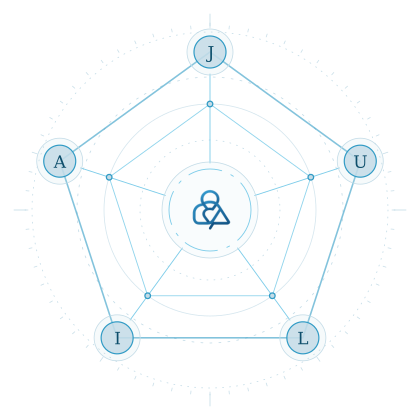
Five dimensions. One human perspective.
Developed by John McClain, JULIA is a self-assessment for people who use conversational AI. It asks whether those interactions remain grounded, autonomous, and honest.
- Justice
- Fairness, attention to human stakeholders, and precise moral language.
- Understanding
- A realistic view of AI capabilities, limitations, and the feelings you may project onto it.
- Liberty
- Your autonomy, time boundaries, and ability to make independent choices.
- Integrity
- Honesty with yourself and others about how you use AI.
- Accountability
- Ownership of decisions, including decisions informed by AI.
JULIA assesses human interactions with AI. The Awareness Indicator Protocol concerns AI systems; the proposed Verifiable Partnership Audit concerns organizations. These are separate instruments.
Read the profile as a starting point.
The current assessment has six questions per dimension. Each asks how frequently an experience occurred over the previous 30 days: Never, Rarely, Sometimes, Often, or Always.
Fourteen items describe protective behaviors and are reverse-scored. Each dimension ranges from 6 to 30 points; lower scores reflect more of the boundaries the instrument is designed to explore. Results show your five dimensions and practical reflection prompts, rather than an overall judgment.
The source's provisional bands are 6–12, 13–18, 19–24, and 25–30. They have not been calibrated against validation data. Certain designated items receive a separate reflection prompt when answered Often or Always, regardless of the total.
The five-question daily check is a separate, unscored reflection. A “no” identifies something to revisit, not a failure.
Earlier alpha materials
These archived PDFs use an earlier yes/no/sometimes format and a different scoring system. Their results cannot be compared with the current browser assessment.
Earlier alpha question set (PDF)
Earlier scoring examples (PDF)
An evolving instrument, openly documented.
JULIA is in alpha. No pilot or validation studies have been completed, and no psychometric evidence is claimed. Its questions, five-dimension structure, and score thresholds remain untested.
- Responses depend on self-awareness and may be shaped by what feels socially acceptable.
- A 30-day snapshot can miss rapid changes or the context behind a response.
- The current instrument focuses on conversational AI and was developed from largely English-language material.
- Questions and scoring may change between revisions, making scores across versions incomparable.
- The instrument was developed by one author without an external review board.
Use the results for personal reflection and dialogue. They are not a medical diagnosis or a basis for clinical, employment, or other consequential decisions.
Found an unclear question or a missing perspective? Share feedback with the author.